Every time your email client filters a suspicious message into spam, your phone suggests the next word as you type, or a chatbot routes your support question to the right department, natural language processing is doing the work. It’s one of the most widely deployed branches of AI, and yet the explanation most people get is either too vague (“it’s how computers understand language”) or too technical to be useful.
This guide takes a different route. It explains what NLP actually is, how the main techniques work in practical terms, where the field sits relative to machine learning and large language models, the tasks that define it, and the limitations that are still very much active problems in 2026. No programming background needed.
The Core Idea: Making Human Language Machine-Readable
Human language is extraordinarily messy from a computational standpoint. Words change meaning depending on context. Sentences can be grammatically identical but mean opposite things. Sarcasm, idiom, dialect, and cultural reference all add layers that a simple keyword matcher can’t navigate Natural language processing is a part of artificial intelligence that helps computers understand human language — turning unstructured language into formats that computers can classify, search, compare, extract information from, or generate.
The key word is unstructured. A database of product prices is structured it has defined fields, predictable formats, and no ambiguity about what each entry means. A sentence like “the bank was steep” is not structured in that way. The word “bank” means something different depending on whether you’re walking next to a river or inside a financial institution, and a system that can’t resolve that ambiguity will fail on a huge proportion of real-world text.2 Natural language processing combines methods from computer science, linguistics, and artificial intelligence. It draws on all three because the problem has three layers: the computational challenge of processing language at scale, the linguistic knowledge needed to understand grammatical structure and meaning, and the AI techniques needed to learn those patterns from data rather than hardcoding every rule.
How NLP Works: The Processing Pipeline
When text enters an NLP system, it doesn’t go straight to meaning. It moves through a series of processing stages, each adding a layer of understanding.
Tokenization
14 Tokenization is the process of breaking down text into smaller units called tokens. Tokens can be words, phrases, or even individual characters. Tokenization forms the basis for various NLP tasks, such as text classification, named entity recognition, and machine translation.
To a computer, a raw sentence is a string of characters with no inherent structure. Tokenization imposes structure by splitting that string into meaningful units usually words, but sometimes subword pieces in modern systems. The sentence “Apple announced a new product” becomes five discrete tokens that can be analyzed individually and in relation to each other.
Part-of-Speech Tagging
Once the text is tokenized, the system needs to understand what grammatical role each word plays. Is “run” a verb (the team runs) or a noun (a trial run)? Part-of-speech tagging assigns each token a label noun, verb, adjective, preposition which helps downstream tasks interpret meaning. The same word can carry completely different implications depending on its grammatical function.
Named Entity Recognition
13 Named Entity Recognition (NER) is a key technology in NLP that enables machines to identify and categorize the essential pieces of text. In practice, this means teaching a system to recognize that “Elon Musk” is a person, “Tesla” is an organization, “California” is a location, and “$45 billion” is a financial figure and to make these identifications reliably across millions of documents. 4 A simple example: given the sentence “Ravi is happy with the new phone,” an NLP system can detect Ravi as a person, identify phone as an object, recognize sentiment as positive, and understand the topic as a product review. That simultaneous multi-level analysis entities, sentiment, and topic all from one sentence is what makes NLP so useful for processing large volumes of text that no human team could read manually.
Sentiment Analysis
Sentiment analysis determines the emotional tone of text. Is a product review positive, negative, or neutral? Is a social media post expressing enthusiasm or frustration? The technique is used for everything from monitoring brand reputation to analyzing patient feedback in healthcare anywhere an organization needs to understand how people feel about something across a large volume of unstructured text.
The hard version of this problem is more interesting than the simple positive/negative classification. 25 Understanding sarcasm requires an intuitive grasp of humor and social cues, posing a significant challenge for NLP tasks. Sarcasm is a pragmatic act, where meaning depends not only on words but also on speaker intent, emotional tone, and shared context. That dependency on context on things that aren’t in the text itself is why sentiment analysis is still an active research area despite decades of progress.
Semantic Analysis and Understanding
Beyond the structure of a sentence lies its meaning. Semantic analysis is concerned with what a piece of text actually says, not just how it’s arranged grammatically. 6 Natural language understanding (NLU) is a subset of NLP that focuses on analyzing the meaning behind sentences allowing the software to find similar meanings in different sentences or to process words that have different meanings.
This is the layer that allows a search engine to understand that “best budget smartphone 2026” and “cheap phone recommendations this year” are expressing the same underlying need, despite sharing no words in common.
NLP vs. Machine Learning vs. LLMs: Where Each Fits
This is the distinction that most introductions handle poorly, so it’s worth being precise. 5 NLP is the field the entire branch of AI concerned with machines understanding, interpreting, and generating human language. Large language models like GPT, Gemini, and Claude are tools within that field.
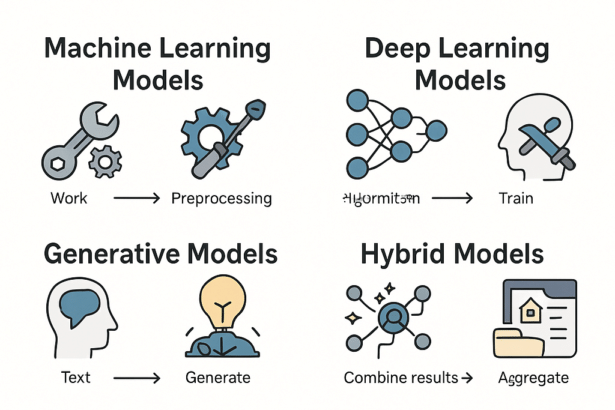
Machine learning is the predominant approach used to build NLP systems; the models learn language patterns from data rather than following hand-coded rules. Deep learning, particularly the transformer architecture, is the specific technique that has driven most of the progress since 2017. 1. Modern NLP pipelines combine tokenization, parsing, entity recognition, embeddings, and inference. Large language models expand on these capabilities but do not replace every task-specific NLP model.
That last point matters. Large language models are impressive general-purpose systems, but many real-world NLP deployments use smaller, specialized models a sentiment classifier fine-tuned on customer reviews, a named entity recognizer trained on medical records, an intent classifier built for a specific customer service domain. These task-specific models are often faster, cheaper to run, and more accurate within their domain than a general-purpose LLM.
The nesting, then: NLP is the field. Machine learning specifically deep learning is the primary technique. LLMs are one powerful category of output, sitting alongside many other models that also count as NLP.
Where NLP Shows Up in Daily Life
The most useful way to understand NLP’s scope is to see where it already operates, often invisibly.
Email. Spam filters are among the oldest and most widely deployed NLP applications. They classify emails using features of the text, routing junk before it reaches your inbox. Modern filters use deep learning models trained on billions of examples.
Search. When you type a query and get relevant results even though the results don’t contain your exact words, that’s semantic search an NLP technique that matches the meaning of your query to the meaning of documents, not just the surface keywords.
Voice assistants. The moment you say something to a phone or smart speaker, an NLP system transcribes your speech into text (speech-to-text), interprets your intent (natural language understanding), and generates a response (natural language generation).
Translation. Modern translation tools use neural machine translation, a deep learning approach that produces natural-sounding translations by learning from billions of sentence pairs, rather than applying grammatical rules mechanically.
Customer service. Chatbots that route your support ticket to the right department, automatically tag incoming messages by topic, or draft responses to common queries are all NLP applications. The better ones use intent classification and entity extraction to understand what a customer is asking without a human reading every message.
Medical records. Clinicians write notes in unstructured prose. NLP systems extract diagnoses, medications, procedures, and clinical findings from those notes, making the data available for research, billing, and care coordination without manual transcription.
The Core NLP Tasks, Summarized
| Task | What It Does | Example |
|---|---|---|
| Tokenization | Breaks text into processable units | “I love NLP” → [“I”, “love”, “NLP”] |
| POS Tagging | Labels each word’s grammatical role | “run” tagged as verb vs. noun |
| Named Entity Recognition | Identifies people, places, organizations, etc. | “London” → Location |
| Sentiment Analysis | Determines emotional tone | Review classified as positive |
| Machine Translation | Converts text between languages | English → French |
| Text Classification | Assigns text to a category | Email → spam or not spam |
| Text Summarization | Condenses long text into shorter form | News article → three-sentence summary |
| Question Answering | Produces answers from text | Customer query → relevant response |
| Speech Recognition | Converts spoken language to text | Voice command → typed instruction |
The Honest Limitations
NLP has come a long way but treating it as a solved problem leads to brittle systems and real-world failures.
Ambiguity is a structural challenge. 19 Human language is inherently ambiguous. The same sentence can mean different things depending on tone, cultural background, industry context, and conversation history. “Close the case” in healthcare, legal, and customer support contexts means entirely different things. 19 Even advanced LLMs struggle with sarcasm, idioms, implicit references, and long-range dependencies. Context windows help but reasoning consistency remains a technical hurdle.
Domain-specific vocabulary is a persistent gap. 19 General-purpose language models are trained on broad internet data. They often fail in specialized environments such as legal documentation, clinical notes, financial reporting, and manufacturing workflows. Without fine-tuning or retrieval-augmented generation, outputs become generic, inaccurate, or non-compliant.
Bias in training data becomes bias in the model. 5 Models inherit bias from their training data, which can quietly skew hiring tools, credit decisions, and content moderation. Because NLP systems learn what’s normal from text produced by humans which reflects human history, culture, and prejudice they absorb those patterns along with everything useful.
Low-resource languages are underserved. 5 Dialects, slang, and low-resource languages get worse performance than standard English. Most NLP research and training data is concentrated in a handful of languages. Systems trained predominantly on English or Mandarin perform significantly worse in languages with smaller digital footprints.
Sarcasm and humor remain hard. 25 Large language models generally perform poorly on sarcasm classification and generation tasks due to the subtlety and context dependence of sarcastic language. Traditional sentiment analysis and machine learning techniques also struggle with these challenges.
None of these are reasons to distrust NLP tools wholesale. They are reasons to be thoughtful about where NLP is deployed, what failure modes are acceptable, and when human oversight is still necessary.
Where NLP Sits in 2026: Still Evolving
The transformer architecture introduced in 2017 shifted NLP from a collection of specialized models toward a general-purpose approach where a single large model, trained on enough text, could handle a wide range of language tasks. That shift is what produced ChatGPT, Claude, Gemini, and the generation of conversational AI tools that followed.
But NLP in 2026 is not just large language models. Retrieval-augmented generation (RAG) which gives a language model access to a verified knowledge base before it generates a response is an NLP technique addressing the hallucination and currency problems of pure LLMs. Smaller, fine-tuned models for specific domains are often more practical than general LLMs for high-stakes applications where accuracy is non-negotiable. And the underlying tasks tokenization, named entity recognition, sentiment analysis, classification are alive and being refined in countless specialized systems that most users never see directly.
The way NLP shows up in your life has changed dramatically in five years. The core problem it addresses helping machines work with the way humans actually speak and write is still very much active.
The Takeaway
Natural language processing is the branch of AI dedicated to making human language computable turning text and speech into structured information that machines can understand, extract meaning from, and generate. It encompasses a pipeline of techniques, from the basic (tokenization and part-of-speech tagging) to the sophisticated (semantic analysis and machine translation), and it powers everything from your inbox filter to enterprise knowledge systems. Large language models are NLP’s most visible output in 2026, but they sit inside a much broader field that includes many specialized, task-specific systems. The limitations ambiguity, bias, domain gaps, and difficulty with sarcasm are genuine and unsolved. Understanding both sides of that is what allows you to evaluate any language AI claim with appropriate realism.
Suggested Internal Links:
- Article: What Is Artificial Intelligence? A Simple Explanation “how NLP fits within the broader AI field”
- Article: What Is Machine Learning? “the machine learning techniques that power NLP”
- Article: What Is Deep Learning? “the deep learning architectures behind modern NLP”
- Article: What Is Generative AI? “how generative AI builds on NLP to create text”
- Article: What Is ChatGPT and How Does It Work? “how ChatGPT uses NLP under the hood”
External Sources:
- AWS — “What is Natural Language Processing?”
- GeeksForGeeks — “Introduction to Natural Language Processing (NLP)”
- GraphWise.ai — “Natural Language Processing (NLP) Explained: Foundations and Architecture”
- Shaip.com — “NLP in 2026: Trends, Use Cases & Future of Language AI”
- Vocal Media — “Key Challenges and Considerations in Natural Language Processing”
- Sarc7 paper — sarcasm classification challenges in LLMs (2026)
- Berger.team — “What Does Natural Language Processing Mean? Glossary 2026”
Read More on AI Global Class