Most people have used generative AI without being entirely sure what it is. If you’ve typed a question into ChatGPT, asked Gemini to draft an email, or seen an AI-generated image on social media, you’ve already seen it in action. But “generative AI” as a phrase still makes a lot of people reach for a vague definition they’re not fully confident in.
This guide clears that up not with jargon, but with the actual explanation. It covers what generative AI is and how it differs from other kinds of AI, how the main types work under the hood (in plain terms), where it shows up in everyday life, and the real limitations that are worth understanding before you rely on it. No technical background needed.
The Core Distinction: Creating vs. Predicting
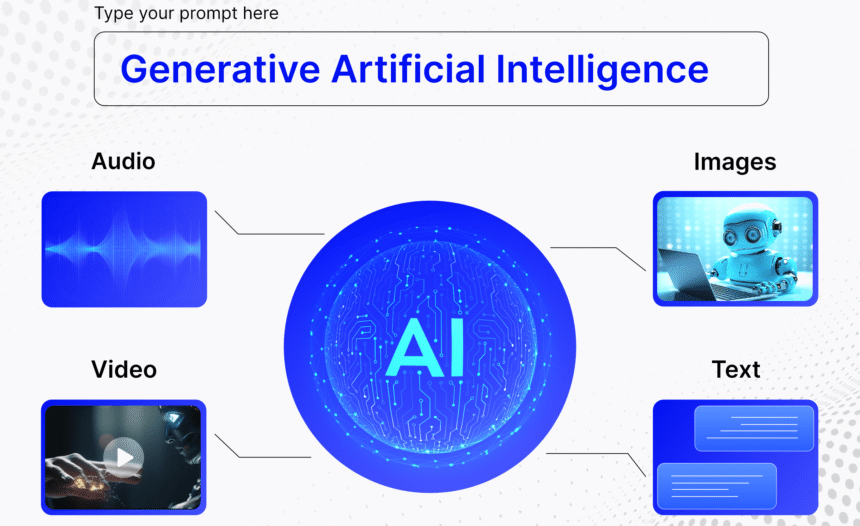
Most AI that existed before 2020 was built to classify or predict. A spam filter classifies an email as junk or not. A recommendation algorithm predicts which video you’ll watch next. A fraud detection system predicts whether a transaction looks suspicious. These systems analyze input and produce a judgment, a category, or a probability. 5 Generative AI is artificial intelligence that can create original content such as text, images, video, audio, or software code in response to a user’s prompt or request. That’s the defining word: *create*. Instead of analyzing something that already exists and rendering a verdict, generative AI produces something new. Instead of only recognizing patterns or making predictions, generative AI can create something new; it can write text, generate images, compose music, summarize reports, build charts, write code, and even help design products.
The distinction matters because it changes what these systems are useful for. A predictive AI tells you whether an X-ray looks abnormal. A generative AI writes a draft radiology report. Both are AI; only one creates.
How Generative AI Learns: The Training Process
5. Generative AI relies on sophisticated machine learning models—deep learning models that work by identifying and encoding the patterns and relationships in huge amounts of data and then using that information to understand users’ natural language requests or questions and respond with relevant new content.
That process has a name: training. During training, a model is exposed to an enormous collection of text examples from the internet, millions of images, and hours of audio and learns the statistical patterns within that data. It isn’t memorizing the examples. It’s building a compressed representation of the patterns: how words tend to follow each other, how shapes and colors appear together in realistic images, and what code that solves a particular kind of problem looks like.
When you give the trained model a prompt, it uses those patterns to generate something new that fits the same statistical shape as what it learned from. For text, that means producing words that plausibly continue your sentence. For images, it means producing pixels that plausibly form the scene you described. The model isn’t retrieving stored content; it’s generating new content from patterns it internalized.
The Three Main Types of Generative AI Models
14 The five major generative AI model types are GANs, VAEs, diffusion models, transformers, and flow-based models, each taking a different mathematical approach to the same goal of producing realistic new output. For most readers, three of these matter practically: transformers, diffusion models, and GANs.
Transformers: The Engine Behind Text AI
14 Transformer models are used in almost all recent large language models, including ChatGPT, Claude, and Gemini.
A transformer processes text by paying attention to relationships between words across an entire sentence or passage at once, rather than reading word-by-word in sequence. That “attention” mechanism is what lets it understand context, knowing that “bank” means something different in “river bank” versus “bank account” depending on the surrounding words. 5 In 2017, Ashish Vaswani and a team at Google Brain published “Attention is All You Need,” a paper documenting the principles of transformer models, widely acknowledged as enabling the most powerful foundation models and generative AI tools being developed today. That single paper is the architectural origin of most generative text AI in use today.
When you type a prompt into a chatbot, the transformer model calculates, token by token, what is most statistically likely to come next, building a response word by word, drawing on the patterns of language it absorbed during training.
Diffusion Models: The Engine Behind Image AI
Image generators like DALL-E and Midjourney use a different architecture. 13. Diffusion models create data by simulating a process that gradually transforms noise into meaningful content. They work by first adding noise to the data in a forward process and then learning to reverse this process, effectively denoising the data to generate new, realistic samples.
Imagine starting with pure visual static random pixels and having a system that progressively refines that noise into a coherent image, guided by your text description. Each step removes a little more noise and adds a little more structure until a recognizable image emerges. 13 These models have gained prominence in generating high-quality images by refining random noise into detailed and coherent outputs, surpassing traditional models like GANs in stability and quality.
This is why AI image generation looks so much better today than it did three years ago. The underlying approach changed.
GANs: The Competing Networks
Generative Adversarial Networks, or GANs, use a different mechanism entirely. 16 GANs use two competing neural networks: a generator that creates content and a discriminator that evaluates how realistic that content looks. The generator tries to fool the discriminator, while the discriminator tries to correctly identify what’s real and what’s generated.
Through that adversarial competition, a bit like a forger and an art detective pushing each other to improve, both networks get better over time. The generator eventually produces outputs realistic enough to pass scrutiny. 10 GANs are less common since diffusion models emerged in 2022–2023. GANs were dominant for image generation from 2014 to 2021 but have been largely superseded by diffusion models, which offer better quality and training stability. They’re still used in specific applications like video and real-time generation where speed matters more than maximum quality, but the flagship image tools have moved on.
What Generative AI Can Actually Produce
The outputs vary by modality, and it helps to see the full range:
| Modality | What It Produces | Examples |
|---|---|---|
| Text | Essays, code, summaries, emails, analysis | ChatGPT, Claude, Gemini |
| Images | Photorealistic images, illustrations, art | DALL-E, Midjourney, Stable Diffusion |
| Audio | Voiceovers, music, sound effects | ElevenLabs, Suno, Udio |
| Video | Short clips, animated sequences | Runway Gen-4, Google Veo |
| Code | Complete programs, functions, debugging | GitHub Copilot, ChatGPT |
| Multimodal | Combinations of the above in one interaction | GPT-4o, Gemini 1.5 |
4 AI videos are no longer demos; they’re entering production pipelines. Text generation is solved. Reasoning is the new battleground. That’s a fair summary of where the field sits in 2026: the impressive outputs that felt novel two years ago are now baseline, and the competition has shifted toward reasoning and reliability.
A Brief History: Why 2022 Was the Turning Point
Generative AI didn’t arrive suddenly. The research foundations go back decades, and the technology existed in limited form for years before most people had heard of it. 5 In 2014, the first generative adversarial networks (GANs) and diffusion models appeared. These were research tools, not products anyone could use. 5 In 2019–2020, OpenAI rolled out its GPT large language models, GPT-2 and GPT-3. In 2022, OpenAI introduced ChatGPT, a front-end to GPT-3 that generates complex, coherent, and contextual sentences and long-form content in response to end-user prompts.
That last step giving the technology a simple chat interface anyone could use changed everything. ChatGPT reached 100 million users faster than any consumer product in history at the time, not because the underlying technology was new but because it was suddenly accessible to people with no technical background at all. AI has been a hot technology topic for the past decade, but generative AI, and specifically the arrival of ChatGPT in 2022, thrust AI into worldwide headlines and launched an unprecedented surge of AI innovation and adoption.
Where Generative AI Shows Up in Daily Life
The applications have spread faster than most people tracked:
Writing and communication: drafting emails, summarizing documents, translating text, editing prose, and generating reports.
Education explaining concepts in different ways, generating practice questions, creating study guides, and tutoring students through problems.
Code and software writing functions, debugging, converting code between programming languages, and generating documentation.
Creative work generating images for presentations, creating music for videos, producing voiceovers without recording sessions, and generating video clips for content creators.
Search and research tools like Perplexity return cited answers instead of links, synthesizing sources rather than listing them.
Business customer support bots, internal knowledge tools, content creation pipelines, and data summarization. 5 According to research by McKinsey, one third of organizations are already using generative AI regularly in at least one business function. Industry analyst Gartner projected more than 80% of organizations would have deployed generative AI applications or used generative AI application programming interfaces by 2026. Whether that prediction landed precisely or not, the directional trend is clear: it’s moved from experiment to standard business infrastructure faster than most predicted.
Generative AI vs. Other AI: The Key Differences
The confusion between types of AI is common and understandable, because they often share the same underlying techniques. A clean comparison helps:
Predictive AI takes an input and returns a judgment yes/no, a probability, a classification. It doesn’t create anything. The spam filter, the credit score model, the medical imaging classifier are all predictive AI.
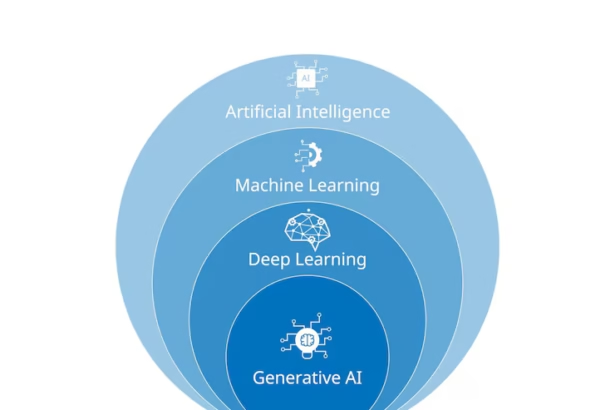
Generative AI takes an input (usually a prompt or a description) and returns something new a piece of content it assembled from the patterns it learned. The chatbot, the image generator, and the code assistant are generative. 3 Generative AI is a subset of artificial intelligence that generates new content meaningfully and intelligently. It sits within the broader AI family, alongside predictive AI and other types, but its defining characteristic is output, not classification.
One more distinction worth making: narrow AI versus general AI. Every generative AI system in existence today is narrow it does one kind of thing well. A text generator cannot generate images. An image model cannot write code. Even multimodal models that handle multiple types of content are architecturally quite different from a general intelligence that could adapt to any task the way a human can. That kind of general AI doesn’t exist yet.
The Real Limitations: What Generative AI Can’t Do
This part gets skipped in a lot of introductions, which is exactly why it belongs here.
Hallucination. 14 Generative AI models are still struggling with issues like hallucinations. Models sometimes produce confidently wrong responses, as they make predictions based on plausible patterns rather than facts. A chatbot can cite a paper that doesn’t exist, state an incorrect date with complete confidence, or misattribute a quote all while sounding entirely authoritative. Fluency and accuracy are separate properties. A well-constructed false sentence is still false.
Bias. 14 If there is any form of skewness in the training data, then the output will be biased as well, especially when used for applications like hiring or lending. Because these models learn from human-generated content, they absorb whatever was skewed, stereotyped, or underrepresented in that content. This shows up in ways that range from subtle to significant.
No real-time knowledge (by default). A model’s knowledge is frozen at the point of its training data cutoff. Without web access enabled, a model doesn’t know what happened last week. Many tools now give models optional web access to address this, but it’s worth checking which mode you’re using.
Copyright and ownership questions. 14 Who owns AI-generated art or text is still being argued out in courts and policy circles worldwide. This is an open legal question, not a settled one, and the answer varies by jurisdiction and is still evolving.
No understanding, just pattern matching. Generative AI doesn’t comprehend what it produces. It generates statistically plausible outputs, which is not the same as understanding what those outputs mean. This is why it can write a grammatically perfect argument for a factually wrong position, and why it needs a human in the loop for anything that matters.
What “Foundation Models” Means and Why It Matters
You’ll often see the term foundation model alongside generative AI, and it’s worth knowing what it refers to. 3 Foundation models are large generative AI models trained on a broad spectrum of text and image data. They are capable of performing a wide variety of general tasks like answering questions, writing essays, and captioning images.
The key idea is that one large model, trained on enormous general data, can be the foundation for many different applications. Companies build specialized products on top of the same foundation a customer support bot, a coding assistant, and a creative writing tool might all run on the same underlying model, just configured differently for each use case.
This explains why the AI landscape looks the way it does in 2026: a small number of very large foundation models (GPT, Claude, Gemini, Llama) serving as infrastructure, with a large number of specialized tools built on top of them.
The Takeaway
Generative AI is the branch of artificial intelligence that creates new content text, images, audio, video, and code by learning patterns from vast amounts of existing data and applying those patterns to produce something new. It runs on two main architectures: transformers for text and multimodal outputs, and diffusion models for images and increasingly video. It became widely accessible in 2022 and has moved from novelty to everyday infrastructure with striking speed.
The mental model worth keeping: generative AI is a pattern-based creation system, not a reasoning mind. It produces plausible outputs, not guaranteed accurate ones. Understanding that gap between confident-sounding and reliably correct is the single most useful thing you can take from this guide. From there, using these tools well is a matter of knowing which ones fit which task, verifying what matters, and staying curious about a technology that is genuinely still changing.
External Sources:
Read more articles on: AI Global Class