You ask an AI chatbot a question and get a confident, well-written answer complete with a specific statistic, a named study, maybe even a quote. It all sounds authoritative. The unsettling part is that any of it might be completely made up, invented by the AI and delivered with exactly the same confidence as a true answer. This behavior has a name: AI hallucination, and it’s one of the most important things to understand about how these tools actually work.
This guide explains what AI hallucinations are in plain terms, why they happen, what they look like in real life (including a famous case that landed lawyers in trouble), how to spot them, and practical ways to avoid being misled. If you use AI for anything where accuracy matters schoolwork, research, work tasks understanding hallucinations isn’t optional. It’s the single most important safeguard against trusting a tool that can be convincingly, confidently wrong.
The Simple Definition
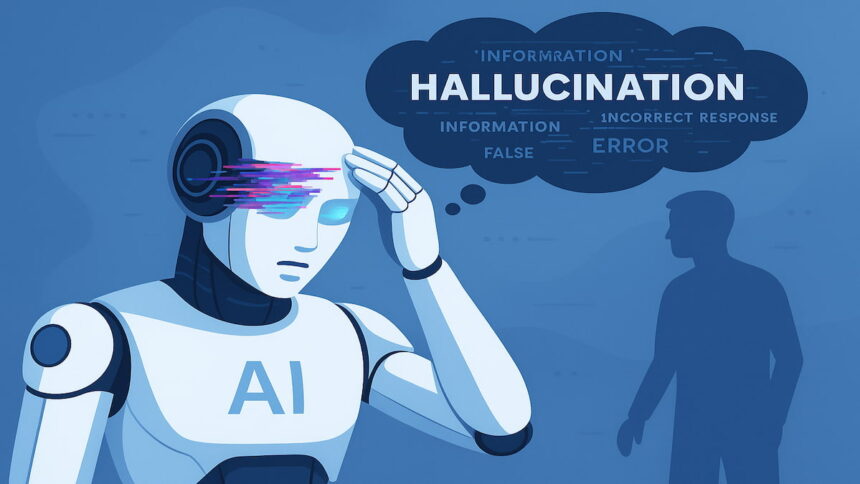
An AI hallucination is when an AI system generates information that is false, made up, or not supported by its source while presenting it as if it were true. The AI isn’t lying in any intentional sense; it has no concept of truth or deception. It simply produces output that sounds plausible but isn’t real.
The word “hallucination” is a useful metaphor: like a person seeing something that isn’t there, the AI “perceives” and reports patterns that don’t correspond to reality. It can invent facts, statistics, dates, names, events, quotes, and even citations to books or studies that were never written all phrased as fluently and confidently as its accurate answers. That confidence is exactly what makes hallucinations dangerous: there’s usually no tone of uncertainty to warn you.
Why AI Hallucinations Happen
To understand why hallucinations occur, you have to understand what a chatbot is actually doing. A large language model like ChatGPT doesn’t look up facts in a database. It generates text by predicting the most likely next word, based on patterns it learned from enormous amounts of text during training.
This design is the root cause. The model is built to produce plausible language, not verified truth. Most of the time, plausible and true overlap the most likely continuation of “The capital of France is” really is “Paris.” But when the model doesn’t actually “know” something, it doesn’t stop or say “I’m not sure.” It generates the most statistically plausible-sounding answer anyway, which can be entirely fabricated. The system has no built-in mechanism to check whether what it’s saying is real.
A few specific causes make hallucinations more likely:
- Gaps in training data. When the model lacks solid information on a topic, it fills the gap with plausible-sounding invention.
- Obscure or very specific questions. The rarer the information, the more likely the model is guessing.
- Leading or false-premise prompts. Ask it to explain something that doesn’t exist, and it may happily invent an explanation rather than correct you.
- Requests for specifics it can’t recall. Exact statistics, dates, page numbers, and citations are especially prone to fabrication.
Crucially, hallucination isn’t a bug that will be simply switched off. It’s a side effect of how these models fundamentally work, which is why even the newest and most capable models still do it, just less often.
What AI Hallucinations Look Like
Hallucinations come in several recognizable forms. Knowing the types helps you stay alert to them.
Fabricated facts and statistics. The AI states a precise-sounding number or fact that’s simply wrong a made-up percentage, an invented historical detail, a nonexistent product feature.
Fake citations and sources. This is one of the most notorious types. The model generates references authors, titles, journals, dates for papers, books, or articles that don’t exist. The citations often look completely real.
Invented quotes. It attributes a statement to a real person who never said it, or makes up a quote wholesale.
Confident wrong answers to reasoning problems. It can get math, logic, or step-by-step problems wrong while explaining the (incorrect) reasoning convincingly.
Made-up details about real things. Asked about a real book, person, or event, it may add plausible-sounding details that are fabricated.
The common thread is confidence. A hallucination rarely announces itself it reads just like a correct answer, which is precisely why it slips past people.
Real and Famous Examples
One of the most widely reported real-world cases involved lawyers who used ChatGPT to help write a legal brief in 2023. The tool generated citations to court cases that didn’t exist, the lawyers submitted them without checking, and the fabrication was discovered in court, leading to sanctions. It became a cautionary tale precisely because the fake cases looked so convincingly real complete with plausible case names and citations.
Similar incidents have recurred across professions: fabricated references appearing in articles and reports, invented details in AI-generated summaries, and made-up facts confidently stated in response to everyday questions. Some are merely amusing an AI inventing a biography for a person who never existed, or confidently describing a fake historical event. Others, like the legal case, carry real consequences.
The pattern across all of them is the same: the AI produced something false but plausible, and a human trusted it without verifying. That human step is where the damage happens and where it can be prevented.
How Common Are They?
Hallucinations are common enough that you should assume any unverified factual claim from an AI might be one. Exact rates are hard to pin down and vary widely depending on the model, the type of question, and how “hallucination” is measured, so you should treat any single headline statistic with caution. What’s well established is that rates are higher for obscure topics, specific facts, and citations, and lower for common, well-documented information.
The practical takeaway matters more than any precise figure: newer models hallucinate less than older ones, but none have eliminated it, and for anything important you cannot assume accuracy. Better models reduce the risk; they don’t remove the need to verify.
How to Spot AI Hallucinations
You can’t always tell a hallucination from the text alone that’s the challenge but certain signals should raise your suspicion:
- Specific claims you can’t easily verify. Exact statistics, dates, and figures deserve a check, especially on niche topics.
- Citations and sources. Treat every AI-provided reference as suspect until you confirm it exists and says what the AI claims. This is the single most reliable red flag.
- Oddly perfect or convenient details. If an answer fits suspiciously neatly, be cautious.
- Obscure or very specific topics. The less common the subject, the higher the hallucination risk.
- Internal inconsistency. If the answer contradicts itself or doesn’t quite cohere when you examine it, that’s a warning sign.
A simple test: if you’d be embarrassed or harmed by the information being wrong, verify it independently before relying on it.
How to Avoid Being Misled
You can’t stop AI from hallucinating, but you can protect yourself from the consequences. A few practical habits:
- Verify anything that matters. Check facts, figures, dates, and especially citations against reliable, independent sources. This is the golden rule.
- Never trust AI-generated citations without confirming them. Look up each source yourself.
- Use source-grounded tools for factual work. Tools that cite real sources (like Perplexity) or that answer only from documents you provide (like NotebookLM) reduce hallucination risk because their answers are tied to actual material though you should still check the sources.
- Ask the AI to cite sources you can check then actually check them, since it can fabricate those too.
- Be specific and provide context in your prompts; vague or leading prompts invite invention.
- Use AI for understanding, not as a final authority. It’s excellent for explaining concepts and drafting; it’s unreliable as a source of record.
- Cross-check across sources for important facts rather than relying on a single AI answer.
The mindset that serves you best: treat AI as a knowledgeable but unreliable assistant whose work you always verify, not an oracle that’s always right.
Why This Matters for Students and Professionals
For students, hallucinations are a direct risk to grades and integrity. Submitting an essay with a fabricated statistic or a fake citation which AI readily produces can mean a wrong answer or an academic misconduct problem. Never cite a source an AI gave you without confirming it exists, and verify factual claims against your course materials.
For professionals, the stakes can be higher still, as the sanctioned lawyers discovered. Any AI-assisted work that goes to a client, a court, a publication, or the public needs human verification of every factual claim. The time saved by AI is only a saving if it doesn’t cost you a credibility disaster later.
The Takeaway
AI hallucinations are when an AI confidently generates false or made-up information fabricated facts, statistics, quotes, and especially citations because these systems are built to produce plausible-sounding language, not verified truth. They happen as a side effect of how the technology fundamentally works, which means even the best models still do it, and no amount of improvement fully removes the need for human checking. The defense is straightforward and non-negotiable: verify anything that matters, never trust an AI citation without confirming it, and treat AI as a capable assistant rather than an authority. Used with that healthy skepticism, these tools remain enormously useful. Used with blind trust, they’ll eventually hand you a confident, convincing, completely false answer, and the only thing standing between that and a real mistake is you.
Suggested Internal Links:
- Article: What Is ChatGPT and How Does It Work? “how ChatGPT actually works”
- Article: How to Use ChatGPT for Beginners “how to use ChatGPT effectively”
- Article: Best AI Research Tools for Students “AI research tools that cite real sources”
- Article: What Is Generative AI? “how generative AI creates content”
External Sources:
- IBM — “What are AI hallucinations?” explainer
- Reporting on the 2023 Mata v. Avianca case (lawyers sanctioned for fake AI-generated citations), via major news outlets
- OpenAI and Anthropic — documentation on model limitations and accuracy
- Academic and industry research on hallucination rates in large language models