Machine learning is the engine behind almost every “smart” piece of technology you use: the spam filter that catches junk mail, the app that recommends your next show, and the bank alert when a charge looks off. The term gets thrown around constantly, often interchangeably with “AI,” but it refers to something specific and surprisingly understandable: machine learning is a way of getting computers to learn from examples instead of being explicitly programmed with rules.
That one idea—learning from data rather than following hand-written instructions—is the whole foundation. This guide explains what machine learning actually is in plain language, how a computer “learns,” the main types you’ll hear about, where it already shows up in daily life, and how it fits alongside AI and deep learning. No math or coding background required.
The Core Idea in One Sentence
Traditional software does exactly what a programmer tells it to, step by step. Machine learning flips that: instead of writing the rules, you give the computer lots of examples and let it figure out the rules itself.
Consider spotting spam email. Writing explicit rules for it is hopeless; spammers constantly change tactics, and any rule you write (“flag anything with the word ‘free'”) catches legitimate mail and misses clever junk. Machine learning takes a different route: show the system millions of emails already labeled “spam” or “not spam,” and it learns the patterns that distinguish them on its own. When a new email arrives, it applies those learned patterns to make a judgment.
The computer was never told what spam is. It worked out from examples, and that’s the essence of machine learning.
How a Computer Actually “Learns”
“Learning” sounds mysterious when applied to a machine, but the process is concrete. It happens in a few stages.
Data comes first. The system needs a large set of relevant examples—emails, photos, transactions, whatever the task involves. More and better data generally means better learning.
Then it trains. The system makes a prediction, compares it to the correct answer, sees how far off it was, and adjusts itself slightly to do better. Then it does this again and again, across all the examples, often millions of times. Each small adjustment nudges it toward accuracy.
The result is a model. Once training is done, the patterns the system discovered are captured in what’s called a model. This trained model is the usable product: feed it something new, and it applies what it learned to produce an answer.
A helpful way to picture it: it’s like learning to recognize birds. Nobody gives you a precise definition covering every species. You see many birds, get corrected a few times (“that’s actually a bat”), and gradually build an instinct for what counts. Machine learning builds that same kind of pattern-based instinct, stored as numbers in software rather than in your memory.
The Main Types of Machine Learning
Machine learning isn’t one single method. It comes in a few broad approaches, and knowing them makes the field much clearer.
Supervised Learning
This is the most common type, and the spam filter is a classic case. In supervised learning, the training data is labeled; each example comes with the correct answer attached. The system learns to map inputs to outputs by studying these labeled pairs, then applies that mapping to new, unlabeled data.
Examples: predicting house prices from past sales (labeled with actual prices), diagnosing disease from labeled medical images, or sorting email as spam or not. If you’ve got examples with known right answers, supervised learning is usually the tool.
Unsupervised Learning
Here, the data has no labels, and the system’s job is to find structure or patterns on its own. It isn’t told what to look for; it groups similar things together or spots relationships humans might miss.
A common use is customer segmentation: give the system data on shoppers, and it clusters them into natural groups (say, “frequent small buyers” and “occasional big spenders”) without being told those categories exist. It’s useful when you want to discover patterns you didn’t already know about.
Reinforcement Learning
This type learns by trial and error, through rewards and penalties. The system takes actions, gets feedback on whether they were good or bad, and gradually learns a strategy that maximizes rewards much like training a pet with treats.
It’s behind some of the most striking AI achievements, like systems that taught themselves to master complex games, and it’s used in robotics and some self-driving car research. It shines where the system can practice repeatedly and learn from the outcomes.
| Type | Data used | Typical goal |
|---|---|---|
| Supervised | Labeled examples | Predict or classify from known answers. |
| Unsupervised | Unlabeled data | Find hidden patterns or groups. |
| Reinforcement | Feedback from actions | Learn a strategy by trial and error. |
Where Deep Learning Fits In
You’ll often hear “deep learning” alongside machine learning, and the relationship is simple: deep learning is a type of machine learning.
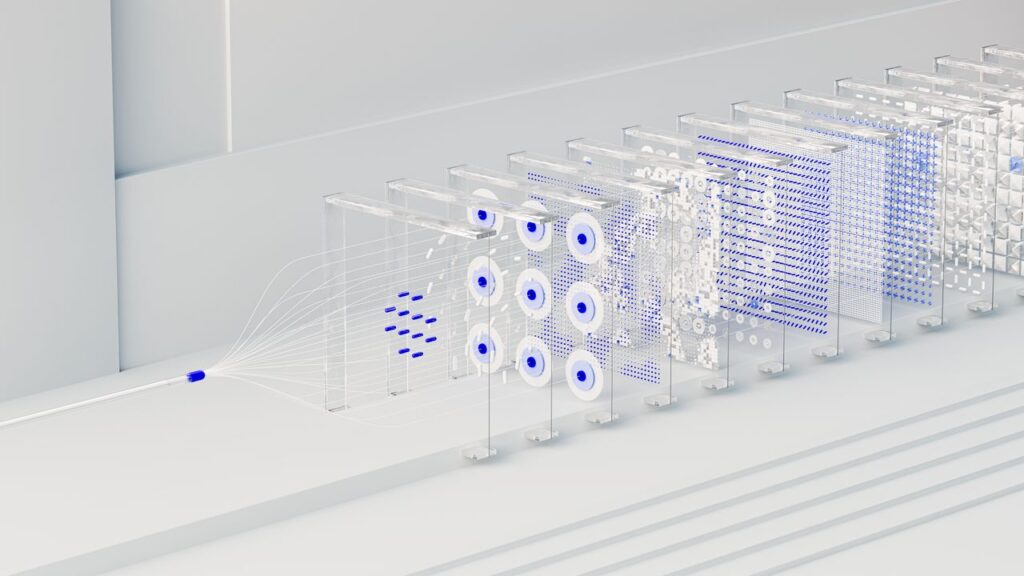
Deep learning uses structures called neural networks—systems loosely inspired by how brain cells connect, built from many layers of simple units. “Deep” just means there are a lot of layers. This approach is especially good at handling messy, complex data like images, audio, and language, which is why it powers most of the recent advances in AI, including the large language models behind chatbots.
So the nesting goes: artificial intelligence is the broad goal of making machines act intelligently, machine learning is the main approach to getting there (learning from data), and deep learning is a powerful technique within machine learning. Each sits inside the one before it.
Machine Learning You Already Use
This isn’t abstract technology; it’s quietly running through daily life:
- Recommendations on streaming, shopping, and social apps, predicting what you’ll like from patterns in your behavior
- Spam and fraud detection, flagging suspicious emails and transactions
- Navigation apps, predicting traffic and estimating arrival times
- Photo apps, recognizing faces and letting you search by what’s in a picture
- Voice assistants, turning speech into text and commands
- Email and phone keyboards, predicting your next word
Each of these is learned from huge amounts of data rather than being hand-programmed with rules, and each gets better as it processes more.
What Machine Learning Can’t Do
Being realistic about the limits matters, because they follow directly from how it works:
- It’s only as good as its data. If the training data is incomplete, outdated, or biased, the model inherits those flaws, a well-documented problem where biased data produces biased predictions.
- It finds correlations, not necessarily causes. It can spot that two things occur together without understanding why, which can mislead if taken as cause-and-effect.
- It can be confidently wrong, especially in situations unlike anything in its training data.
- It doesn’t understand meaning the way people do; it recognizes patterns, which is powerful but not the same as comprehension.
These limits don’t make machine learning unreliable to the point of uselessness. They mean it works best as a powerful tool guided and checked by humans, not an infallible oracle.
Why Machine Learning Took Off
The ideas behind machine learning have existed for decades, so why does it feel so recent? Three things converged. The internet created vast amounts of digital data to learn from. Computer chips became powerful enough to train large models. And better techniques, especially deep learning, dramatically improved what was possible. Together, these turned a mostly academic field into the technology running much of modern life and the one powering the current wave of AI tools.
The Takeaway
Machine learning is the practice of building computer systems that learn from examples rather than following hand-written rules, spotting patterns in data, and using them to make predictions or decisions on new information. It comes in a few flavors (supervised, unsupervised, and reinforcement learning), includes the powerful sub-field of deep learning, and already runs quietly behind recommendations, spam filters, maps, and far more. Hold onto the one central idea: learning patterns from data, not genuine understanding, and both machine learning and the broader world of AI become much easier to make sense of. It’s not magic; it’s pattern-finding at a scale and speed no human could match, which is exactly what makes it so useful and so worth understanding.
Suggested Internal Links:
- Article: What Is Artificial Intelligence? A Simple Explanation “What artificial intelligence actually is”
- Article: How Does AI Work? A Beginner’s Guide “how AI works under the hood”
- Article: What Are AI Models? “how AI models are trained”
- Article: What Is Generative AI? “How generative AI creates content”
External Sources:
- IBM—”What is machine learning?” and “What is deep learning?” explainers
- Stanford University HAI and online machine learning course materials
- MIT Technology Review — coverage of machine learning advances
- Google—Machine Learning crash course and introductory resources
- Read More Articles on AIGlobalClass