Open ChatGPT and you’ll see names like GPT-5 or “Luna.” Open Gemini and there’s a model picker. Read any AI news and you’ll trip over “models,” constantly larger models, reasoning models, and open models. The word gets used as if everyone already knows what it means, which leaves a lot of people quietly unsure.
An AI model is the trained “brain” behind an AI tool, the part that has actually learned to do something from data, which the app then lets you use. This guide explains what that really means in plain language: how a model is made, the difference between a model and an app like ChatGPT, the main types of models you’ll encounter, and what all those product names actually refer to. No technical background needed, and by the end the jargon in AI headlines will make a lot more sense.
The Simple Definition
An AI model is a program that has learned to perform a task by finding patterns in data, rather than by following rules a human wrote out step by step.
That learning part is the key. A traditional program does exactly what it’s told: “If this, then that.” An AI model is different; it’s shown many examples and figures out the patterns itself, then uses those patterns to handle new situations it hasn’t seen before. The finished result of all that learning is the model.
A quick analogy. Think of training a model like teaching someone a skill through practice rather than a rulebook. A chef who’s cooked thousands of dishes develops an instinct for flavor they can apply to a brand-new recipe. An AI model develops something similar to a set of learned patterns, except it’s stored as numbers in software rather than in a person’s head. Once trained, that “instinct” is what you’re using when you interact with an AI tool.
How an AI Model Is Made
Models don’t appear fully formed. They’re created through a process called training, which has a few clear stages.
It starts with data. Developers gather a large collection of examples relevant to the task text, images, sounds, numbers, and whatever else fits. The quality and quantity of this data heavily shape how good the model turns out.
Then the model learns from it. During training, the system makes predictions, checks how wrong they were against the correct answers, and adjusts itself slightly to do better. It repeats this cycle an enormous number of times, gradually tuning millions or billions of internal settings (called “parameters”) until it performs well.
The result is the trained model. All those learned patterns are captured in the model’s parameters, essentially a vast set of numbers that encode what it figured out. This trained model is the valuable end product. It can then be given new inputs and produce useful outputs based on what it learned.
You’ll often hear parameters mentioned as a rough measure of a model’s size; a model with more parameters has more capacity to capture complex patterns, though bigger isn’t automatically better.
A Model Isn’t the Same as the App
This is a distinction that clears up a lot of confusion. The model is the trained brain; the app is the product you actually click on.
ChatGPT, for example, is an application made by OpenAI. The models behind it are from the GPT family. The app provides the chat window, the buttons, the voice feature, and the file uploads, and it sends your messages to a model, which generates the responses. One app can even offer a choice of several models, which is why you sometimes see a dropdown letting you pick.
The same split applies elsewhere:
| App (the product) | Maker | Model family (the brain) |
|---|---|---|
| ChatGPT | OpenAI | GPT |
| Gemini | Gemini | |
| Claude | Anthropic | Claude |
| Copilot | Microsoft | Built on OpenAI’s GPT models |
So when you hear “GPT-5” or “Gemini,” those are models, the underlying engines, while ChatGPT and Gemini (the app) are the interfaces that let you use them. The model names and version numbers change often as makers release improved versions.
The Main Types of AI Models
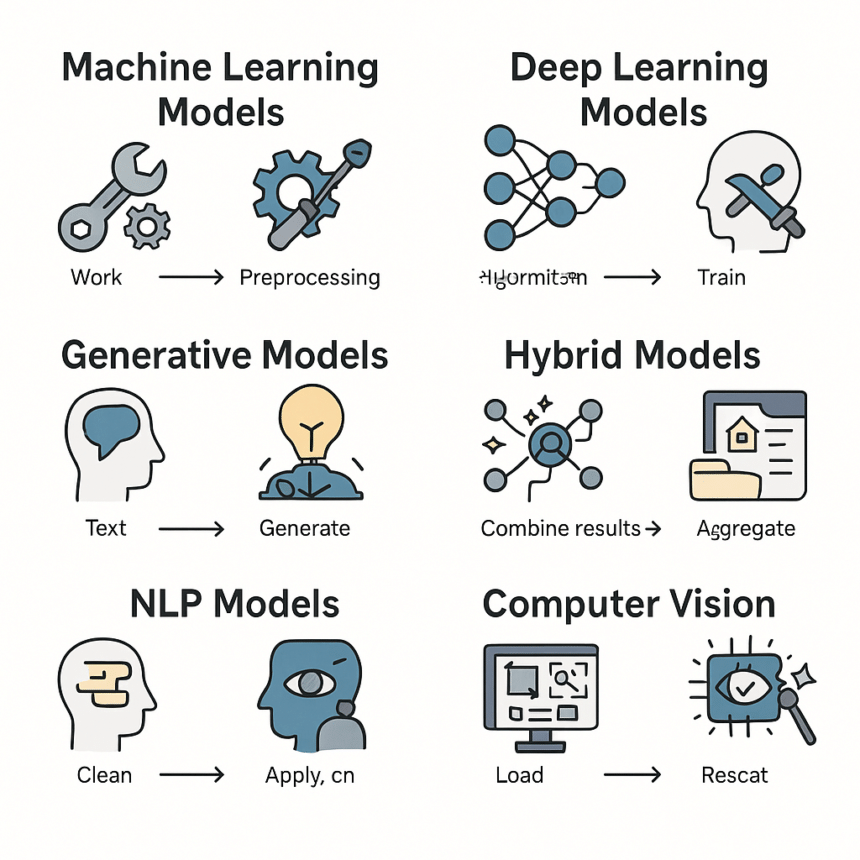
“AI model” is a broad term covering many kinds, each built for different jobs. A few categories are worth knowing.
Large Language Models (LLMs)
These are the models behind chatbots and the ones most people mean today. A large language model is trained on massive amounts of text and learns to work with language, answering questions, writing, summarizing, and more. GPT, Gemini, and Claude are all large language models. At their core, they generate text by predicting likely next words, which at scale produces remarkably coherent writing.
Image Models
These generate or analyze pictures. Some create images from text descriptions (like the tools behind AI art generators), while others recognize what’s in a photo. They’re trained on large collections of images rather than text.
Multimodal Models
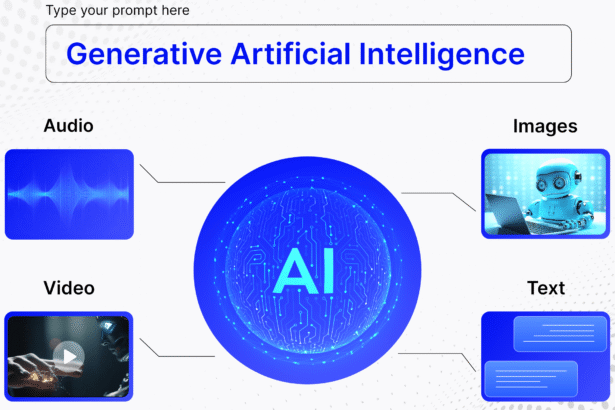
Newer models are often multimodal, meaning they handle more than one type of input and output text, images, audio, and sometimes video all in one. You can show a multimodal model a picture and ask about it in words, or describe something and get an image back. Most leading models in 2026 have multimodal abilities built in.
Other Specialized Models
Beyond these, countless models do narrower jobs: predicting outcomes from data (predictive models), recognizing speech, recommending what you’ll watch next, or detecting fraud. These don’t make headlines like chatbots, but they quietly run much of the technology around you.
A broad distinction worth keeping: some models mainly analyze or predict (sorting an email as spam, forecasting a trend), while others are generative (creating new text or images). Both are AI models; they just do different things with what they learned.
“Reasoning” Models and Why They Appeared
A more recent development you’ll see mentioned: reasoning models. These are models designed to “think” through a problem in steps before answering, rather than responding instantly. They tend to do better on complex tasks like math, logic, and coding, at the cost of taking a bit longer.
Many current AI apps offer both a fast standard mode and a slower reasoning mode. The “think longer” button you might have noticed is often switching to this kind of model behavior. For everyday questions the standard model is fine; for hard problems, the reasoning approach can be worth the wait.
Open vs. Closed Models
One more distinction that comes up in the news. Some models are “closed,” owned by a company, and accessible only through their app or service (GPT and Gemini are examples). Others are “open” (sometimes called open-source or open-weight), meaning the model itself is released publicly so anyone can download, run, or build on it. Meta’s Llama models are well-known open examples.
For everyday users this rarely matters directly, but it shapes the broader landscape: open models let researchers, smaller companies, and hobbyists build their own AI tools without starting from scratch, while closed models are controlled by their makers.
What AI Models Can’t Do
Understanding models also means understanding their limits, which come straight from how they’re built:
- They’re only as good as their training data. Gaps, biases, or outdated information in the data show up in the model’s behavior.
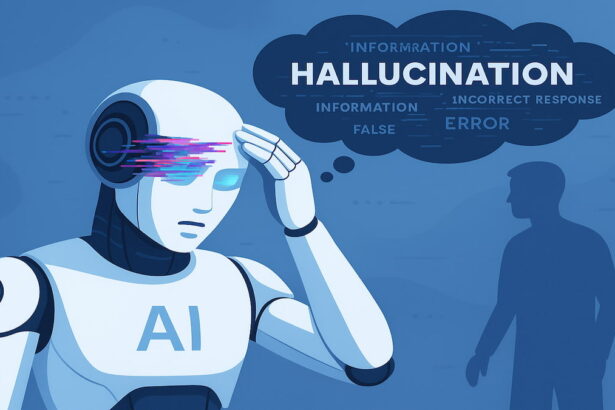
- They can be confidently wrong. Generative models especially can produce plausible but false output, since they generate patterns rather than retrieve verified facts.
- They don’t truly understand meaning the way people do; they work with patterns, which is powerful but not the same as comprehension.
- A model’s knowledge has a cutoff. Unless connected to live data, it only “knows” what it was trained on up to a certain point.
None of this makes models unreliable to the point of uselessness; it means they’re powerful tools that need human oversight, especially for anything factual.
The Takeaway
An AI model is the trained core of any AI tool, a program that learned to do a task by finding patterns in large amounts of data, then stored that learning as a set of internal numbers it uses to handle new inputs. The model is the brain; apps like ChatGPT, Gemini, and Claude are the products that let you use it, which is why one app can offer several models and why version names change so often. Most models you’ll meet today are large language or multimodal models, with newer “reasoning” versions that work through problems step by step. Hold onto the core idea: models learn patterns from data; they don’t truly understand, and the constant stream of model names and announcements becomes far easier to follow.
Suggested Internal Links:
- Article: What Is Artificial Intelligence? A Simple Explanation “What artificial intelligence actually is”
- Article: How Does AI Work? A Beginner’s Guide “how AI works under the hood”
- Article: What Is Generative AI? How generative AI creates content”
- Article: What Is ChatGPT and How Does It Work? “The models behind ChatGPT”
External Sources:
- IBM “What is an AI model?” and “What is a large language model?” explainers
- Google, OpenAI, and Anthropic—official documentation on their model families
- Stanford University HAI—foundation models research and explainers
- MIT Technology Review—coverage of reasoning models and open vs. closed models