If you’ve come across the “30% rule in AI” and assumed it was an official standard a safe line where keeping AI-generated content under 30% makes your work acceptable or undetectable this article will save you from a costly misunderstanding. The short, honest answer is that there is no official, universal “30% rule” in AI. It’s an informal idea that circulates online, interpreted in different ways, and it doesn’t carry the authority or reliability people assume.
That matters, because students and writers sometimes treat this “rule” as permission or protection, only to run into trouble when it turns out no such guaranteed threshold exists. This guide explains what people actually mean when they reference a 30% rule, why no percentage makes AI use genuinely safe or honest, where the confusion comes from, and more usefully what actually determines whether your AI use is acceptable. If you want a real answer instead of a myth, this is it.
The Direct Answer: There’s No Official 30% Rule
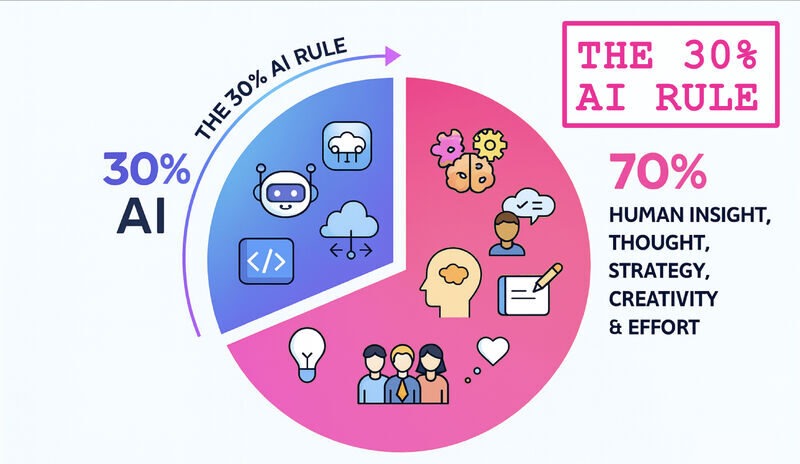
Let’s be clear from the start. No major educational body, publisher, or AI company has established an official “30% rule” that says AI-generated content is acceptable as long as it stays under 30% (or any other specific figure). The phrase floats around forums, social media, and casual advice, but it isn’t a recognized standard you can point to or rely on.
When people reference it, they usually mean one of a few different things, which is part of the problem the “rule” has no single, authoritative definition. Treating a vague internet rule of thumb as if it were policy is where people get into trouble. The safe assumption is that it carries no official weight anywhere that matters to you.
What People Usually Mean by It
The “30% rule” gets used loosely in a few ways. Understanding each helps you see why none of them is dependable.
As an academic “safe zone.” Some students interpret it as “if less than 30% of my work is AI-generated, it’s fine / won’t be flagged.” This is the most common and most dangerous interpretation, because it treats a made-up threshold as a rule and relies on detection working a certain way neither of which holds up.
As an AI-detector score. Sometimes it refers to AI-detection tools reporting a percentage of text as “likely AI-generated,” with a vague sense that under 30% is acceptable. But detector percentages are unreliable (more on that below), so building a rule on them is shaky.
As a content or SEO guideline. In writing and marketing circles, some suggest keeping AI-generated content to a minority of a piece (sometimes cited around 30%) to maintain quality and originality. This is more of an informal best-practice opinion than a rule, and it varies by who’s saying it.
As a general “keep it minimal” idea. Occasionally it’s just shorthand for “use AI sparingly and do most of the work yourself” reasonable advice, but not a precise, enforceable rule.
The thread across all of these: it’s an informal guideline or interpretation, not a fixed standard, and people apply it inconsistently.
Why No Percentage Makes AI Use “Safe” or Honest
Here’s the deeper reason to stop chasing a magic number. Whether your AI use is acceptable isn’t really about how much AI touched the work it’s about how you used it and whether you followed the actual rules that apply to you.
Consider two cases. A student who used AI only for 10% of a paper, but that 10% was a fabricated statistic passed off as a researched fact, has a real problem, small percentage notwithstanding. Meanwhile, a student who used AI for brainstorming and feedback across the whole project but wrote every word and did all the thinking themselves may be completely within the rules, even though AI “touched” far more than 30%.
Percentage is the wrong measure. What matters is
- Did you do the actual thinking and writing, or did AI replace it?
- Did you follow your institution’s or publisher’s specific policy?
- Did you verify and attribute properly, rather than passing off AI fabrications or others’ work as your own?
A threshold like 30% ignores all of this. You could stay “under” it and still cheat; you could go “over” it and still be entirely honest. That’s why no number offers the safety people hope for.
The Detection Problem Behind the Myth
Part of the 30% rule’s appeal is the belief that it lets you stay under a detector’s radar. But AI detectors are genuinely unreliable. They produce false positives (flagging human writing as AI) and false negatives (missing AI text), and reporting has shown they can be especially prone to wrongly flagging non-native English speakers. Because of this, some institutions have limited or stopped using them.
This unreliability cuts against the 30% rule in both directions. You can’t trust a detector’s percentage as a meaningful measure of anything, so a rule based on staying under some detector score is built on sand. And relying on detection to be lenient is risky, because people also get caught through means that have nothing to do with detectors’ inconsistencies with their known ability, an inability to explain their work, or required process evidence like drafts. A percentage won’t protect you from any of that.
What Actually Determines Acceptable AI Use
Instead of a mythical number, here’s the real framework, and it’s more useful because it’s actually true.
Your institution’s or organization’s policy. This is the only “rule” that genuinely governs you, and it varies widely. Some courses ban AI for assignments, some allow it for brainstorming or editing but not writing, and many now require you to disclose how you used it. Policies increasingly differ by course and even by assignment. Read the syllabus and ask your instructor when unclear; that’s the standard that matters, not a forum rule.
Whether the work is genuinely yours. The core principle across most policies is that the thinking and writing should be your own. Using AI to support your work (understanding, feedback, brainstorming) is broadly acceptable; using it to produce work you submit as yours is usually not.
Honesty and disclosure. If your institution requires acknowledging AI use, do it. Transparency is far safer than trying to stay under an imaginary line.
Accuracy and attribution. Verify anything AI tells you (it fabricates facts and citations), and attribute real sources properly. This matters regardless of percentage.
| The myth | The reality |
|---|---|
| Stay under 30% and you’re safe | No threshold guarantees acceptability |
| Detectors measure a reliable percentage | Detectors are unreliable, both ways |
| Percentage decides if it’s okay | How you used AI and your policy decide |
What to Do Instead of Chasing a Percentage
Practical advice if you want to use AI without risk:
- Find and follow your actual policy the real rule, not an internet rule of thumb.
- Use AI to support, not replace, your work brainstorm, understand, get feedback, proofread then write and think for yourself.
- Disclose AI use when required.
- Verify AI’s facts and cite real sources.
- Keep your drafts and notes, so you can show your work is genuinely yours if ever questioned.
Do these, and you don’t need a percentage at all your AI use is legitimate by design, which is far more protective than any threshold could be.
The Takeaway
The “30% rule in AI” is not an official or reliable standard it’s an informal idea people interpret in several ways, none of which actually make AI use safe or honest. Whether your use of AI is acceptable doesn’t come down to a percentage of AI-generated content; it comes down to how you used the tool, whether the thinking and writing are genuinely yours, and whether you followed the specific policy that applies to you.
AI detectors can’t reliably measure such a threshold anyway, and people get caught through many channels a percentage won’t shield them from. So stop chasing a magic number and focus on what’s real: know your institution’s rules, use AI to support your own work rather than replace it, be honest and verify what it tells you, and keep evidence of your process. That approach protects you far better than any 30% rule ever could because it’s not a myth.
Suggested Internal Links:
- Article: How to Use AI Without Cheating “using AI without crossing the line”
- Article: “How to Use AI Without Getting Caught“”the honest truth about AI detection”
- Article: How to Use AI for Research Without Getting Misled “using AI for research responsibly”
- Article: Can Students Use ChatGPT for Homework? “whether students can use ChatGPT for homework”
Read More On AI GLOBAL CLASS