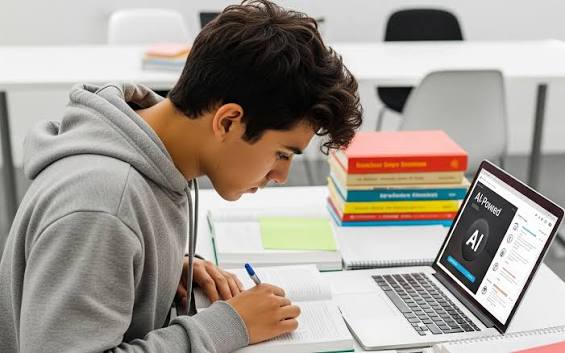
Yes, but that one-word answer hides everything that actually matters. Whether students can use ChatGPT for homework depends entirely on how they use it and what their school allows. The same tool can be a legitimate study aid in one situation and an academic integrity violation in another, sometimes on the very same assignment.
This article gives you the real answer, not a vague one. It covers what “using ChatGPT for homework” actually means in practice, which uses are widely accepted and which get students in trouble, what schools and teachers are actually saying, and how to use the tool in a way that helps you learn instead of undermining it. If you’ve been wondering where the line is, this will make it clear.
The Honest Short Answer
Using ChatGPT to help you do your homework is generally fine. Using ChatGPT to do your homework for you is generally cheating. Almost everything comes down to that distinction.
If you use it to understand a tricky concept, check your reasoning, or get feedback on your own work, you’re using it the way you’d use a tutor or a study group and most schools have no problem with that. If you paste in the assignment, copy the answer, and submit it as your own, that’s the kind of use that violates academic integrity policies at nearly every institution, no matter how you dress it up.
The complication is that “generally” isn’t “always.” Rules vary, so the first thing any student should do is find out what their specific school and teacher permit.
Rule Number One: Check Your School’s Policy
Before anything else, this matters more than any general advice. Policies on AI vary widely some schools ban ChatGPT for assignments, some encourage it, and many allow it for certain tasks but not others. Increasingly, the rules differ from one class to the next, because individual teachers set their own expectations.
So check three places before using ChatGPT on graded work:
- The syllabus or course outline, which often now includes an AI-use statement.
- The specific assignment instructions, since a teacher may allow AI on one task and forbid it on another.
- The teacher directly, if it’s unclear. A short, honest question “Is it okay to use ChatGPT to help me understand this or check my work?”protects you and signals good faith.
Assuming a use is fine without checking is how students end up in academic misconduct meetings over something they didn’t realize was against the rules.
Uses That Are Usually Fine
These ways of using ChatGPT support your learning rather than replace it, and they’re broadly accepted (though always confirm with your own course):
- Explaining a concept you don’t understand. Ask it to break down a hard idea, give an analogy, or walk through a worked example. This is like having a tutor on call.
- Checking your own work. After you’ve solved a problem or written a paragraph, ask it to point out errors or weak spots then fix them yourself.
- Brainstorming ideas. Generating possible essay angles or research questions to choose from and develop yourself.
- Getting unstuck. When you don’t know how to start, asking for the first step or an outline approach can get you moving.
- Studying and self-testing. Turning your notes into practice questions and quizzing yourself.
- Understanding feedback or instructions. Asking it to rephrase a confusing assignment prompt in plainer terms.
The common thread: in each case, you’re still doing the actual homework. ChatGPT is helping you learn how, not doing it in your place.
Uses That Usually Count as Cheating
These are the uses that get students in trouble, even when they don’t feel dramatic in the moment:
- Copying ChatGPT’s answer and submitting it as your own work the clearest violation.
- Having it write your essay (or a chunk of it), whether or not you tweak the wording afterward.
- Getting it to answer graded questions problem sets, take-home quizzes, exam questions meant to test what you know.
- Using it to generate citations or sources and submitting them without checking, since ChatGPT frequently invents references that don’t exist.
- Paraphrasing its output to hide that it came from AI. Rewording doesn’t make the thinking yours.
Here’s a useful gut-check for any borderline case: if you’d be uncomfortable telling your teacher exactly how you used ChatGPT, that discomfort is telling you something. Honest, disclosable use is almost always the safe kind.
What Schools and Teachers Actually Think
The picture is genuinely mixed, and it’s worth understanding rather than guessing. Many educators see real value in AI as a learning aid surveys of teachers show a substantial and growing share use AI tools themselves for planning and feedback, and plenty encourage supervised student use for brainstorming and understanding.
At the same time, schools are worried about students outsourcing their thinking. That concern is backed by research: a widely reported study found that students who leaned heavily on ChatGPT to revise essays improved their immediate results but showed weaker ability to apply what they’d learned later the researchers described a risk of “metacognitive laziness,” where students stop doing their own mental work. In plain terms, using AI as a crutch can raise a grade while lowering actual learning.
That’s why the emerging consensus among thoughtful educators isn’t “ban it” or “anything goes.” It’s closer to: use AI to support your learning, not to skip it. The students who benefit are the ones who stay in the driver’s seat.
A Big Caution: ChatGPT Gets Things Wrong

Even where using ChatGPT is allowed, there’s a practical reason not to trust it blindly for homework: it can be confidently, completely wrong. ChatGPT generates plausible-sounding text by predicting words, not by looking up verified facts, so it can produce incorrect answers, fake statistics, and citations to sources that don’t exist a behavior known as “hallucination.”
For homework, this means:
- Never submit a factual answer you haven’t verified. Check math, dates, definitions, and claims against your textbook or a reliable source.
- Never trust its citations. Confirm every source actually exists and says what ChatGPT claims.
- Be extra careful in technical subjects. It can make confident errors in math and science that look right at a glance.
Ironically, this is another reason the “copy the answer” approach backfires you might be copying a wrong answer that a teacher spots instantly.
How to Use ChatGPT for Homework the Right Way
Here’s a workflow that keeps you learning and on the right side of the rules, using a real example. Say you have a math problem set you’re struggling with.
The wrong way: Paste the questions, copy the answers, submit. You learn nothing, you might submit errors, and if AI use is banned, you’ve cheated.
The right way: Attempt each problem yourself first. When you’re stuck, ask ChatGPT to explain the method “I don’t understand how to start this type of problem, can you walk me through the steps with a similar example?” Then apply the method to your actual problem yourself. If your answer seems off, ask it to check your working and point out where you went wrong, and fix it yourself.
The same pattern works for essays (write your draft, then ask for feedback you act on), reading (ask it to explain confusing passages, then do the analysis yourself), and studying (have it quiz you). In every version, you produce the work and ChatGPT supports the process.
Protect Yourself, Even If You Do Nothing Wrong
One more practical point: AI-detection tools are unreliable and sometimes flag genuine student writing as AI-generated, and reporting has shown they can be especially prone to falsely flagging non-native English speakers. That means you could be wrongly accused even if you wrote every word.
To protect yourself:
- Write in Google Docs or Word so you have version history showing your work developed over time.
- Keep your notes, drafts, and outlines as evidence of your process.
- Be ready to explain your own work, which is easy if you actually did it and hard to fake if you didn’t.
These habits are worth it whether or not you use AI at all.
The Takeaway
Can students use ChatGPT for homework? Yes, when it’s used to help you understand, check, and improve your own work and when your school and teacher allow it. It becomes cheating when it does the thinking and produces the work you submit as your own. So check your specific course’s rules first, keep yourself in the driver’s seat, verify anything factual because ChatGPT genuinely gets things wrong, and be willing to disclose how you used it. Used that way, ChatGPT is one of the most useful study aids a student has ever had. Used as an answer machine, it risks both your learning and your academic record and often isn’t even accurate. The tool is fine; the judgment about how to use it is everything.
External Sources:
- British Journal of Educational Technology — “Beware of metacognitive laziness” (Fan et al., 2025)
- OpenAI — ChatGPT usage guidelines and Help Center
Read More On AIGLOBAL CLASS